

Should You Buy the Vision Pro?
The $3,500 Vision Pro is prohibitively expensive for many consumers, and reviews indicate it may not easily integrate into existing workflows for most users. Some buyers have expressed regret after purchasing the headset. While the Vision Pro excels at watching movies, viewing 3D videos, and serving as a display for a Mac, many users find it challenging to identify everyday uses for the device.
Weighing over 1.3 pounds, the Vision Pro can cause fatigue during extended use; however, Apple has improved comfort with the Dual Knit Band introduced with the M5 chip. An external battery pack complicates portability, particularly when considering Apple's dedicated Travel Case.
As Apple's most technically advanced product, the Vision Pro is an impressive engineering achievement. Prospective buyers are advised to try it at the Apple Store and conduct thorough research on its capabilities before making a purchase. While ideal for content consumption, the device has a limited selection of apps and games.
In October 2025, Apple refreshed the Vision Pro with an M5 chip, making now a good time to buy. Another update isn’t expected for at least two years, as development on the next-generation headset is currently paused.
- M2 vs. M5 Vision Pro: 20+ Differences Compared
Apple Vision Pro Overview
Apple Vision Pro represents Apple's entry into the augmented and virtual reality headset market, a product that has been in development for over a decade. This device marks the company's first major new product category since the Apple Watch's debut in 2015. The initial version launched in February 2024, followed by an updated model featuring the M5 chip in October 2025.
Rather than calling it a headset, Apple refers to the Vision Pro as a spatial computer due to its ability to integrate digital content with the physical world. It is the first device of its kind designed for spatial computing.
The Vision Pro is a mixed reality headset capable of displaying augmented reality content overlaid on users' environments, as well as completely immersive virtual content. It’s important to note that the headset is not see-through; all visuals are digital. To create augmented reality experiences, Apple employs cameras that map physical surroundings, translating them into a digital image enhanced by virtual elements.
For a virtual experience, the cameras are disabled, isolating users from their surroundings to focus on the content displayed on the headset. Users can control this shift between reality and immersion using the on-device Digital Crown.
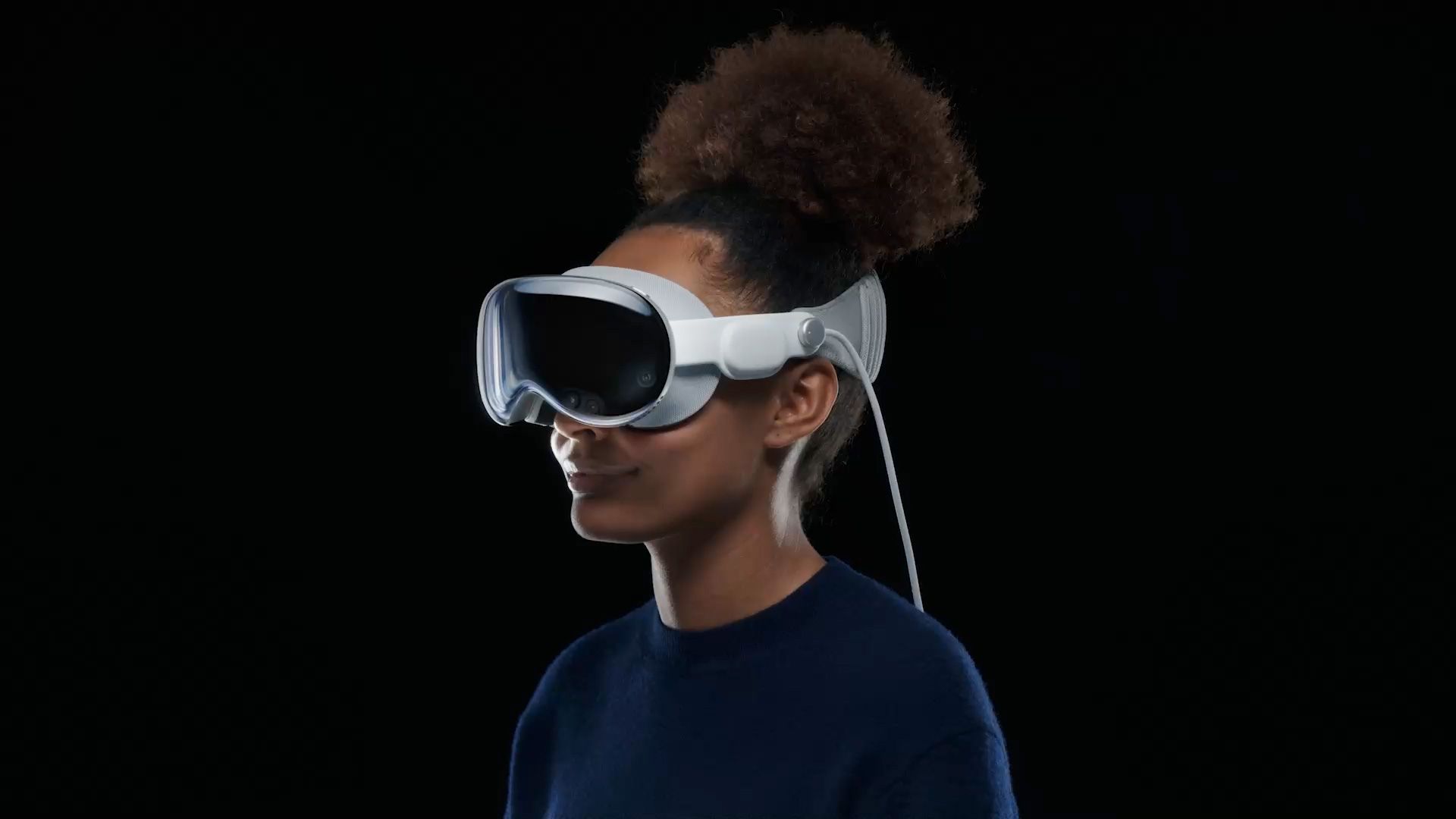
Design-wise, the Vision Pro resembles a high-end pair of ski goggles, featuring a single piece of laminated glass encased in an aluminum alloy frame. A soft, fitted Light Seal attaches magnetically to the frame, conforming to the user's face to block out light.
The headset includes two Audio Straps with built-in speakers that provide Spatial Audio, blending audio from the headset with ambient sounds. The original model included a Solo Knit Band, but the M5 version features a Dual Knit Band for enhanced comfort and fit, incorporating counterweights to distribute weight evenly.
Inside, the Vision Pro boasts two micro-OLED displays delivering over 4K resolution to each eye, totaling an impressive 23 million pixels. An external display known as EyeSight projects an image of the user’s eyes, indicating whether they are in immersive mode or aware of their surroundings. Custom prescription Zeiss Optical Inserts can be added for glasses wearers.
The headset operates without traditional controllers, relying instead on eye tracking, hand gestures, and voice commands. Users can navigate apps by looking at them and open them with a finger tap, while scrolling is achieved with a simple flick.
More than a dozen cameras and sensors monitor the environment, tracking hand and eye movements. Optic ID uses iris scanning for authentication, similar to Face ID and Touch ID, and can be used to unlock the device and make purchases.
Two chips power the Vision Pro: the M5, used in MacBooks, and the R1, which processes inputs from cameras and sensors. The M5 chip runs visionOS, executing computer vision algorithms and enhancing graphics, while the R1 chip delivers a nearly lag-free visual experience by streaming images to displays in just 12 milliseconds.
Users can capture 3D photos and videos with a built-in camera, reliving memories in immersive formats. The Vision Pro is powered via a braided cable connected to a battery pack worn at the hip or a wall adapter, providing up to 2.5 hours of general use on a single charge.
With the Vision Pro, apps and content can be displayed in the user's environment, allowing for an infinite canvas. Users can arrange apps and windows in mid-air or opt for an immersive view that replaces the real world with a virtual background.
The visionOS operating system offers a dedicated App Store and runs iPhone and iPad apps. It can connect to a Mac, serving as a display, while familiar controls are available through Bluetooth accessories. The interface mimics that of the iPhone, allowing for seamless app management.
Vision Pro also enhances FaceTime with a redesigned interface that presents participants in large tiles while creating an accurate digital avatar of the user. The Cinema Environment offers a unique viewing experience, and the headset supports Apple Arcade for gaming.
In terms of purchasing, the M5 Vision Pro can be acquired from the Apple online store and retail locations, starting at $3,500 for 256GB of storage. The ordering process requires a Face ID scan for proper fit adjustments.
What's Next for Vision Pro
Looking ahead, Apple is developing "smart glasses" similar to Meta's offerings. These glasses, scheduled for a potential launch in 2027, will not feature displays but will include audio and camera capabilities. Additionally, there are plans for a lighter, more affordable version of the Vision Pro, the Vision Air, priced around $1,750.
Apple's long-term goals for AR/VR include ongoing development of AR glasses initially intended to connect with the Mac. Future iterations of the Vision Pro may also focus on health applications, utilizing the technology for mental health diagnostics and treatment.
Source: MacRumors News